Frequently Asked Questions About Our Communication Boards
Implementing inclusive play is more than just a physical upgrade; it’s about ensuring every child has a voice. If you are a city planner, school administrator, or community advocate, you likely have technical questions about communication boards. This guide provides the answer to help you navigate the selection process on how to choose a communication board for your community.
Materials, Pricing & Ordering
Design, Customization & Installation
What is the process to order a playground communication board?
Answer: Request a free quote online. Within 24 hours, you’ll receive an email estimate. Once you submit a purchase order, credit card, or check, we will immediately begin processing your order.
What is the cost range for a durable playground communication board?
Answer: Durable aluminum alloy boards (Playground, Pool, Clinic, or Riding) start at $550 for 2’x3′ or 3’x2′ sizes, and $675 for 4’x2′ boards. Lightweight, indoor-friendly Coroplast or Magnetic Tile boards (Clinic or Emotional Balance) start at $200. Customization options are available.
What materials are the playground boards printed on?
Answer: We print our outdoor boards on heavy-duty, 3mm MaxMetal aluminum composite alloy. This weather-resistant material features a protective, UV-resistant coating that repels graffiti and helps reflect extreme summer heat.
When should I choose Coroplast vs. Aluminum?
Answer: Choose aluminum composite for permanent, high-traffic outdoor playgrounds. Choose lightweight Coroplast (corrugated plastic) or magnetic tiles for indoor gyms, therapy clinics, classrooms, or temporary community events.
How do you install the playground communication boards?
Answer: We do not install the boards or sell mounting hardware. However, we provide an installation suggestion guide, and we recommend consulting your local maintenance department for physical installation.
Can the boards include multiple language options?
Yes. Every board can feature up to four languages per cell to serve your community’s diverse needs. Please note there is a one-time setup fee for adding languages other than English.
Where can I find custom communication board design and printing?
Answer: Resources at Lakeshore Speech is run by ASHA-certified speech-language pathologists with over 60 years of combined experience. We can fully customize your board’s layout, send it to production upon your approval, and deliver it directly to your door within 2 to 7 business days.
How do I choose the right symbols for a playground communication board?
Answer: Select symbols by “feature matching” your community’s needs: evaluate the learner’s visual profile for size and contrast, check the symbol’s iconicity (how closely it resembles the real object), and maintain environmental consistency by matching the symbols used in local schools.
How do you teach children and peers to use a playground communication board?
Answer: We teach through a clinical strategy called “aided language modeling.” Adults and neurotypical peers simply point to the symbols on the board while speaking the corresponding words out loud, showing emerging communicators how visual icons translate directly to real-world play.
What is the recommended installation height for a playground communication board?
Answer: For ADA accessibility and ease of use, we suggest installing the board so the top edge sits no higher than 3 feet off the ground, keeping all symbols within easy reach for all children.
Clinical Benefits & Inclusive Play
Funding & Clinical Strategy
How do visual communication boards enhance inclusive play?
Answer: They transform playgrounds by reducing solitary play by 70% and doubling peer-to-peer friendships. By offering a shared visual language, these boards lower behavioral outbursts through faster conflict resolution and teach neurotypical children empathy, creating a truly welcoming, universally designed play space.
What are the benefits of playground communication boards for children?
Answer: They foster inclusive play by helping peers interact, support emotional regulation by letting kids express feelings, enhance playground safety, and build independence by allowing children with communication differences to express their needs without relying on caregivers.
What age group uses playground communication boards?
Answer: Our communication boards are designed for all age groups. While the visual symbols are highly engaging and easy for children, the overall layout is professional and dignified enough for adults in neuro-rehabilitation clinics, group homes, and medical facilities.
Why do children need playground boards if they already have high-tech AAC devices?
Answer: High-tech speech devices are vulnerable to outdoor glare, water damage, dead batteries, and physical impact. Large outdoor communication boards ensure children have continuous, weather-resistant access to their voices during active play without risk to their personal devices.
How do I get funding for a playground communication board?
Answer: Most communities fund their boards through state recreation grants, inclusive play foundations (like Flutie Foundation), or local service clubs such as the Rotary, Kiwanis, or Lions Clubs.
Refer to our Funding Information Page for more informaiton, letter templates, etc.
Where can I buy durable communication boards for therapy use?
Answer: Right here. Our clinical communication boards are available in MaxMetal aluminum, corrugated plastic, or magnetic panels. These materials easily withstand daily cleaning, sanitizing chemicals, and heavy medical or classroom use while keeping the symbols bright and clear.
We offer communication boards for playgrounds, pools/splash pads, clinics, therapeutic riding factilities as well as for emotional regulation. We ship communication boards to all 50 states.
What should I include on a communication board?
Answer: Our boards are pre-designed by speech-language pathologists using evidence-based vocabulary. We handle the complex clinical layout for you, ensuring proper linguistic mapping, sensory-friendly spacing, and the most functional, inclusive mix of core and fringe vocabulary words.
All of our communciation boards are 100% customizable. We will work with you to ensure your customized vocabulary to meet your individual needs.
What symbols should be included on an outdoor playground communication board?
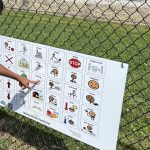
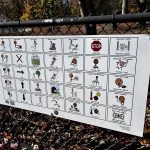
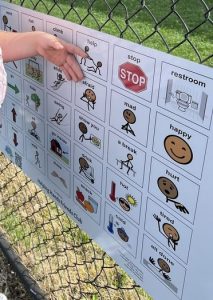
Answer: A functional board should feature a balanced mix of “core vocabulary” words (like go, stop, more, play, help) and playground-specific “fringe vocabulary” words (like swing, slide, hot, bathroom), paired with a clear, color-coded layout like the Fitzgerald Key.
How to choose a playground communication board is a question we get asked frequently. These quick answers to some of the most frequently asked questions help most communities. Selecting AAC communication boards is a question we get asked frequently. These quick answers to some of the most frequently asked questions help most communities.